I have just finished reading the 'Sutra of Hui-Neng', sometimes referred to as the 'Platform Sutra', and am working through his commentary on the 'Diamond Sutra', which is included in Thomas Cleary's translation. It is a work I have read two or three times before, and has many familiar and well-loved stories in it. These days scholars tend to discount the possibility that the Sixth Ancestor actually had anything to do with it - I was going to say wrote it, but he was famously illiterate - and that the whole thing was a propaganda exercise by his followers two or three generations later.
A few years ago, I was able to do one of Shohaku Okamura's Genzo-e sesshins here at City Center, and while the focus of the sesshin is studying Dogen and the Shobogenzo, Shohaku's breadth of knowledge means that he often draws in other subjects. I remember he was talking about how lineage was very important in Chinese culture, especially at the time referred to as the golden age of zen in the generations after Hui-neng; in fact, he said, the idea of having an authentically transmitted lineage was too important for them not to make one up. But does that make what is communicated in the sutra any less valid?
One of the stories I like most in the sutra concerns Yung-chia; the exchange between him and Hui-neng is perhaps my favourite dharma combat, although I have never found a translation of it that I feel really brings out the whole flavour of the exchange in clear language. I really wouldn't claim to understand it, although I did try to present it during a class I did at Tassajara a few summers ago, where I spoke about Yung-chia's 'Song of Enlightenment', which I had been coming across in a few different books and anthologies, but which seemed to have been somewhat neglected, certainly within Zen Center.
This time I enjoyed the story of Fa-ta, who had recited the Lotus Sutra 'as many as three thousand times already', but whose head did not touch the ground when he bowed. Hui-neng admonished him: 'If you just laboriously keep reciting and consider that an accomplishment, how is that different from a yak admiring its tail?' Fa-ta said 'Does that mean I shouldn't bother to recite the sutra, as long as I can understand the meaning?' The Master said 'What's wrong with the sutra? How can it obstruct your mindfulness? It's just that delusion and enlightenment are in the individual; gain and loss depend on oneself. If you recite it and also act on it mentally, then you are reading the sutra; if you recite it but don't practise it mentally, then you are being read by the sutra.'
Friday, May 14, 2010

Wednesday, May 12, 2010
Coming and Going
This morning we had a departing student ceremony, our third one in the past month, all of whom have been for people heading to Tassajara - first my predecessor Greg, then Camilla, and now Konin. The ceremony is fairly simple, but also very significant in that it gives a concrete ritual dimension to a transition.
The format of the ceremony is that the ino lights the altar at the end of zazen, then offers incense, the departing student offers incense and does three prostrations behind the bowing mat. Then the ino leads the student in a jundo - a procession around the zendo - where everyone has their heads bowed and their hands in gassho, starting with a bow to the Abbot and ending with a bow to the Senior Dharma Teacher. The ino then goes back around the altar to the tsui ching - a wooden column with an octagonal-shaped block on top. Resting the right hand on the block, the ino moves it three times around the surface of the tsui ching, then lifts it and brings it down with a clunk, which usually causes people who don't know to expect it to jump. There is a form of words, which today went: 'having aroused way-seeking mind, having entered this temple, having practised faithfully, having contributed to the well-being of this temple, this student, Konin Melissa Cardenas, goes to Zenshinji to continue her practice. You go with our heart-felt gratitude and best wishes'. The ino does two more hits on the tsui ching, and the doan hits two bells. Then comes the fun part, when the Abbot asks the departing student a question, usually along the lines of 'who is it that goes?' or 'is there really any coming and going?', to test the student's ability to respond in the moment, and then there is usually an expression of gratitude for the person's practice as well.
At Tassajara when this ceremony happens, the departing student is then the first person to leave the zendo, which is the part I most remember from my first leaving ceremony there about six years ago, because it really brought home to me that I was going, and I started crying on the engawa.
Now, at Tassajara this is called a departing monk ceremony, and when I announced Greg's departing student ceremony the other week he came by me saying 'that's departing monk ceremony', but I beg to differ with him on this one. Being a literal-minded person most of the time, I feel that when you are at the monastery, you are a monk, and when you are at a temple, like City Center, you are not. I remember how hard it was for me when I moved to Tassajara to get my head around the fact that I was a monk. As I wrote recently, we certainly looked like monks, and that was already something, but it was a big leap for me to go from that stage to accepting that that was how I could describe what I was doing with my life.
I should add that, notwithstanding what I have written above, when I think of the strengths of Greg's and Konin's practice, which I would characterise as making themselves available for whatever needs to be done with a minimum of fuss, I think of them as good monks...
On a personal level, today's ceremony reminded me of what was almost my first act as ino, the shuso entering ceremony, which has a similar format, but obviously marks a different transition. I remember being very nervous about the choreography, but I told myself that I was in charge of the ceremony, or at least that portion of it, and that there was no need to hurry, which helped calm me down in that moment. What I remember very clearly about that morning was laying my hand on the tsui ching, and feeling that it had a life of its own, years of stored ceremonial energy.
One of my first entries here describes the feeling around taking on and embodying a role, just like trying to embody being a monk. I think I can say now, with the practice period underway, and a very purposeful energy in the building with all the new residents, and with the training I have started doing with them, that I feel like I really am the ino now. Whatever that means.
By the way, I tried googling 'tsui ching' to see if there was a picture I could link to, but the answer appears to be no.
The format of the ceremony is that the ino lights the altar at the end of zazen, then offers incense, the departing student offers incense and does three prostrations behind the bowing mat. Then the ino leads the student in a jundo - a procession around the zendo - where everyone has their heads bowed and their hands in gassho, starting with a bow to the Abbot and ending with a bow to the Senior Dharma Teacher. The ino then goes back around the altar to the tsui ching - a wooden column with an octagonal-shaped block on top. Resting the right hand on the block, the ino moves it three times around the surface of the tsui ching, then lifts it and brings it down with a clunk, which usually causes people who don't know to expect it to jump. There is a form of words, which today went: 'having aroused way-seeking mind, having entered this temple, having practised faithfully, having contributed to the well-being of this temple, this student, Konin Melissa Cardenas, goes to Zenshinji to continue her practice. You go with our heart-felt gratitude and best wishes'. The ino does two more hits on the tsui ching, and the doan hits two bells. Then comes the fun part, when the Abbot asks the departing student a question, usually along the lines of 'who is it that goes?' or 'is there really any coming and going?', to test the student's ability to respond in the moment, and then there is usually an expression of gratitude for the person's practice as well.
At Tassajara when this ceremony happens, the departing student is then the first person to leave the zendo, which is the part I most remember from my first leaving ceremony there about six years ago, because it really brought home to me that I was going, and I started crying on the engawa.
Now, at Tassajara this is called a departing monk ceremony, and when I announced Greg's departing student ceremony the other week he came by me saying 'that's departing monk ceremony', but I beg to differ with him on this one. Being a literal-minded person most of the time, I feel that when you are at the monastery, you are a monk, and when you are at a temple, like City Center, you are not. I remember how hard it was for me when I moved to Tassajara to get my head around the fact that I was a monk. As I wrote recently, we certainly looked like monks, and that was already something, but it was a big leap for me to go from that stage to accepting that that was how I could describe what I was doing with my life.
I should add that, notwithstanding what I have written above, when I think of the strengths of Greg's and Konin's practice, which I would characterise as making themselves available for whatever needs to be done with a minimum of fuss, I think of them as good monks...
On a personal level, today's ceremony reminded me of what was almost my first act as ino, the shuso entering ceremony, which has a similar format, but obviously marks a different transition. I remember being very nervous about the choreography, but I told myself that I was in charge of the ceremony, or at least that portion of it, and that there was no need to hurry, which helped calm me down in that moment. What I remember very clearly about that morning was laying my hand on the tsui ching, and feeling that it had a life of its own, years of stored ceremonial energy.
One of my first entries here describes the feeling around taking on and embodying a role, just like trying to embody being a monk. I think I can say now, with the practice period underway, and a very purposeful energy in the building with all the new residents, and with the training I have started doing with them, that I feel like I really am the ino now. Whatever that means.
By the way, I tried googling 'tsui ching' to see if there was a picture I could link to, but the answer appears to be no.
You Say Neither
May 12th marks my ten year anniversary of arriving in San Francisco to take up residential practice. My main reason for coming was actually to get married to someone who was already living at the Zen Center; in fact my application to move in was so light on practice experience that the director of City Center at the time wrote to me to ask 'do you know what you are letting yourself in for?'. I said that I had been given a fair idea of what to expect, though I do remember being somewhat overwhelmed, having gone to bed very early that first day after the long flight from London, to get up and do the entire Saturday morning schedule for the first time.
I have only had one friend in England tell me, on the occasions I have gone back to visit since then, that I sound American, and I think, or I hope at least, that she was referring to my vocabulary more than my accent. Californians tend to assume that I am Australian, which can perhaps be attributed to the somewhat fluid accent I acquired living in London for twelve years, although no-one from England or Australia would make that same assumption.
My pronunciation has caused small ripples during services. This is mainly due to my obstinacy in saying neither (/ˈnaɪ.ðər/) rather than neither (/ˈniː-/ /-ðɚ/), which occurs five times in the Heart Sutra. I am also wont to say path, (/pɑːθ/ rather than /pæθ/) chant (/tʃɑːnt/) and so on, but the neither sticks out most plainly. Indeed one Tassajara tanto, even though he was from New England himself, and I heard him say naɪ.ðər on other occasions, just as I have heard other English people say niː-//-ðɚ, went so far as to publicly forbid naɪ.ðər once when we were having a chanting review, though I confess that I just got a little quieter as I chanted those sections rather than give up my natural way of doing things. At one of the first Practice Committee meetings I went to as ino, there was some gentle ribbing from the Abbot and tanto here as to whether I would be imposing my version on the sangha now. I think I have heard a few defectors recently. I know that it would be good if we all sounded the same, but somehow I just can't bring myself to give it up.
I have only had one friend in England tell me, on the occasions I have gone back to visit since then, that I sound American, and I think, or I hope at least, that she was referring to my vocabulary more than my accent. Californians tend to assume that I am Australian, which can perhaps be attributed to the somewhat fluid accent I acquired living in London for twelve years, although no-one from England or Australia would make that same assumption.
My pronunciation has caused small ripples during services. This is mainly due to my obstinacy in saying neither (/ˈnaɪ.ðər/) rather than neither (/ˈniː-/
/-ðɚ/), which occurs five times in the Heart Sutra. I am also wont to say path, (/pɑːθ/ rather than /pæθ/) chant (/tʃɑːnt/) and so on, but the neither sticks out most plainly. Indeed one Tassajara tanto, even though he was from New England himself, and I heard him say naɪ.ðər on other occasions, just as I have heard other English people say niː-//-ðɚ, went so far as to publicly forbid naɪ.ðər once when we were having a chanting review, though I confess that I just got a little quieter as I chanted those sections rather than give up my natural way of doing things. At one of the first Practice Committee meetings I went to as ino, there was some gentle ribbing from the Abbot and tanto here as to whether I would be imposing my version on the sangha now. I think I have heard a few defectors recently. I know that it would be good if we all sounded the same, but somehow I just can't bring myself to give it up.
Monday, May 10, 2010
A Full Zendo
Ino usually translates as Head of the Meditation Hall, although at the opening ceremony for the practice period, which we did at the end of Saturday's sitting, I called on another translation when I stated my intention for the practice period as 'to manifest the ino as the bringer of joy' - as per Greg's original post on this blog. On certain levels it strikes me as faintly absurd that I could in any way be in charge of the zendo.. As Michael reminded us the other morning during zazen, thousands of people have sat in these seats in the forty years that City Center has been in this building, and they have all left their traces; they are all sitting with us still.
This morning, the first morning of the practice period, we had a full zendo, and a full Buddha Hall as well, with more priests than could fit on the ryoban (the front row usually reserved for ordained priests); the energy was good, and the chanting strong.
I thought I had mentioned the sunlight that has been shining across the zendo in the mornings towards the end of the second period of zazen, but perhaps I didn't after all.Today there was no sun as the rainy weather still lingers; anyway, here are some pictures I took on Sunday morning, which tell me that the zendo does have a life all its own even when no-one is actually sitting.


This morning, the first morning of the practice period, we had a full zendo, and a full Buddha Hall as well, with more priests than could fit on the ryoban (the front row usually reserved for ordained priests); the energy was good, and the chanting strong.
I thought I had mentioned the sunlight that has been shining across the zendo in the mornings towards the end of the second period of zazen, but perhaps I didn't after all.Today there was no sun as the rainy weather still lingers; anyway, here are some pictures I took on Sunday morning, which tell me that the zendo does have a life all its own even when no-one is actually sitting.


Sunday, May 9, 2010
Exposed to the Golden Wind
Saturday turned out to be much less stressful for me than the last one-day sitting, which had been my debut, and I managed to settle down for most of the afternoon. Things happened, of course: people who were expected and didn't come, people who weren't expected and did come, there were a lot of people to try and seat in a way that made sense for the meals, trying to find a replacement for a serving crew, a cell phone that kept ringing in the cloakroom at the end of the hall which certainly tested my patience.
And then there were the windows. Usually we keep one of the upper windows open all the time for a little ventilation. As the zendo was going to be full all day, I had opened a second early in the morning. We have however been having a chilly north-westerly all week here, which was blowing right into the room, and in the afternoon a few people asked me if I could shut them as they were feeling cold. Several things went through my mind: first is a personal preference against stuffiness; then there are memories of exhortations by Dogen and others along the lines of 'if the roof leaks, then do zazen somewhere where the rain does not come in' (Shobogenzo Zuimonki), along with admonitions that monks of old always had it harder and they never complained. But I decided that the compassionate ino should listen to the needs of the assembly and take care of them, so I shut the windows, although I didn't shut one of them hard enough - they are high enough that shutting them involves wielding a long pole with hooks on the end - and it blew open again before the end of the next period...
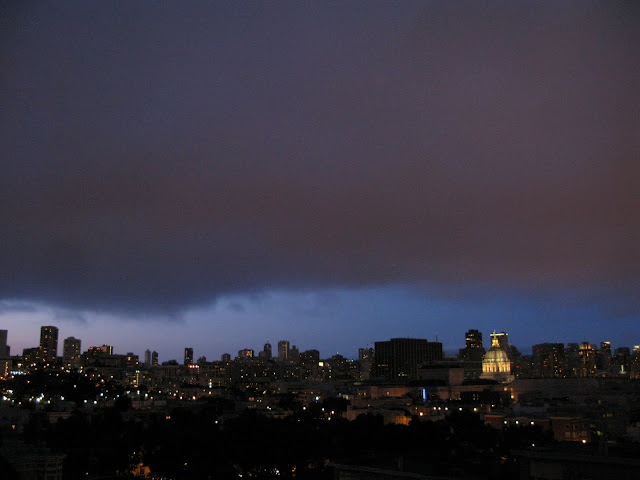
I noticed I haven't put any photos up for a while, so, even though these are not remotely connected to the ino realm, some pictures of the skies of the last few days, with all the changeable weather that the winds have brought. And to give them a zen flavour, one of my favourite quotes, from Kosho Uchiyama, in his commentary on Dogen's 'Bendowa' : 'Only when I look up at the sky does it preach that there is a world in which we do not need to be excited'.



And then there were the windows. Usually we keep one of the upper windows open all the time for a little ventilation. As the zendo was going to be full all day, I had opened a second early in the morning. We have however been having a chilly north-westerly all week here, which was blowing right into the room, and in the afternoon a few people asked me if I could shut them as they were feeling cold. Several things went through my mind: first is a personal preference against stuffiness; then there are memories of exhortations by Dogen and others along the lines of 'if the roof leaks, then do zazen somewhere where the rain does not come in' (Shobogenzo Zuimonki), along with admonitions that monks of old always had it harder and they never complained. But I decided that the compassionate ino should listen to the needs of the assembly and take care of them, so I shut the windows, although I didn't shut one of them hard enough - they are high enough that shutting them involves wielding a long pole with hooks on the end - and it blew open again before the end of the next period...
I noticed I haven't put any photos up for a while, so, even though these are not remotely connected to the ino realm, some pictures of the skies of the last few days, with all the changeable weather that the winds have brought. And to give them a zen flavour, one of my favourite quotes, from Kosho Uchiyama, in his commentary on Dogen's 'Bendowa' : 'Only when I look up at the sky does it preach that there is a world in which we do not need to be excited'.


Thursday, May 6, 2010
All Day Sitting
This week so far has seen a succession of meetings; apart from the regularly scheduled meetings of the Practice Committee, on Tuesday afternoons, and Senior Staff, on Wednesday mornings, I also attended an all-day meeting on Monday, which was looking at the future of City Center. I confess I found it hard to keep my concentration levels up for that one. So this morning, even as we are gearing up for the next practice period, which begins with the one-day sitting on Saturday, I took myself off after breakfast to ride my bike, which as people who know me will attest, is one of my main pleasures in life.
We have almost eighty people signed up for Saturday, and when I sat down this afternoon, my to-do list looked like this: finalise the schedule, allocate jobs, work on the seating chart, assemble two sets of oryoki bowls, check how many spatulas we have for guest eating bowls, find a light-up chiden for tomorrow morning, fill out a vacation request form, look at some documents about sound systems, update the tenken (attendance) list to include all the new arrivals, reprint the tenken notes we give people who don't show up for part of the schedule, find chant sheets for noon service, write the doan and kokyo parts for noon service, and put out a sign-up sheet for people to do the doan jobs. I am happy to say that I managed to do almost all of that before going to the zendo at five fifteen, which means that a lot of the main work is done for Saturday, and now I can allow the hundred other things that I will need to take care of to manifest themselves, which they will. And then sit, and try to do some zazen in the midst of it all.
We have almost eighty people signed up for Saturday, and when I sat down this afternoon, my to-do list looked like this: finalise the schedule, allocate jobs, work on the seating chart, assemble two sets of oryoki bowls, check how many spatulas we have for guest eating bowls, find a light-up chiden for tomorrow morning, fill out a vacation request form, look at some documents about sound systems, update the tenken (attendance) list to include all the new arrivals, reprint the tenken notes we give people who don't show up for part of the schedule, find chant sheets for noon service, write the doan and kokyo parts for noon service, and put out a sign-up sheet for people to do the doan jobs. I am happy to say that I managed to do almost all of that before going to the zendo at five fifteen, which means that a lot of the main work is done for Saturday, and now I can allow the hundred other things that I will need to take care of to manifest themselves, which they will. And then sit, and try to do some zazen in the midst of it all.
Tuesday, May 4, 2010
The Ino Blog Ring
'Please honoured followers' again: I am happy to see that, even though I don't belong to Facebook and indeed have many misgivings about it, each time this blog has been featured on the Zen Center page, or wall or whatever, I have acquired more followers. I still have no idea who is reading this really, but I do recognise some of the names and pictures at least. I hope you are all enjoying yourselves here, and please let me know whether you are or not.
Being more or less technically proficient on this kind of platform, I sometimes find myself getting frustrated with some of the things I don't seem to be able to do, not least of which is leaving comments either here or on other people's blogs. So anyway, thanks to Nedd, and Trevor, and Djinn for recent comments, and a tip of the hat to Trevor's blog, http://thebigoldoaktree.blogspot.com which tells of his life as the ino at Austin Zen Center. If there are any other inos reading, I will add you to the list of blogs I am following.
Being more or less technically proficient on this kind of platform, I sometimes find myself getting frustrated with some of the things I don't seem to be able to do, not least of which is leaving comments either here or on other people's blogs. So anyway, thanks to Nedd, and Trevor, and Djinn for recent comments, and a tip of the hat to Trevor's blog, http://thebigoldoaktree.blogspot.com which tells of his life as the ino at Austin Zen Center. If there are any other inos reading, I will add you to the list of blogs I am following.
Monday, May 3, 2010
Japanese Eko
This evening and tomorrow morning we will be doing our monthly memorial ceremonies for Suzuki Roshi, who died on the morning of the 4th of December 1971. This evening's ceremony is entirely in Japanese, as we chant the Sandokai and use a Japanese dedication as well. This is another of those things we do here that can be off-putting to people who don't see why we should chant something nobody understands.
I was teasing a good friend of mine at Tassajara recently who was the kokyo (that's the person who leads the chants and offers the dedication, and is one of the many Japanese terms we always use at Zen Center, like ino), and listening to her I realised that her style of intoning reminded me of Lady Bracknell, or more particularly, Edith Evans playing Lady Bracknell in the classic film version of 'The Importance of Being Earnest'. She told me that the one time she had felt most comfortable as kokyo was when she did the Japanese eko for the memorial ceremony, as it was the only time she did not try to editorialise as she was chanting.
I think this is a very useful notion. I have enjoyed chanting for many years, as I find it a strong way to continue mindfulness, especially of the breath, after sitting. Nowadays I have memorised almost all the chants we do on a regular basis, so I am not reading as we chant, but letting come out of that part of the brain where these things are stored. The whole process can be very energising; indeed with the dharanis that we chant most days, the Shosaimyo Kichijo Dharani and the Dai Hi Shin Dharani, the point of them is not the meaning of the words but the spirit and energy with which they are chanted, and then whatever positive energy or merit that is created by the chanting, we give away, and the eko, or dedication, tells us to whom we are giving this away.
Personally I love the Japanese chants, as the nature of the language with its strong vowels allows a different energy to come up to a chant in English. But that's not the reason we still chant in Japanese; we do it out of respect and gratitude for our founder, who brought the teachings to us just fifty years ago.
There is much talk these days of how Zen will transform now it is in the west, and eventually I suspect a lot of the Japanese elements will recede and be replaced, but seven hundred years elapsed between Dogen and Suzuki Roshi, so in Buddhist terms, we are just at the beginning. Which is an exciting time to be around.
I was teasing a good friend of mine at Tassajara recently who was the kokyo (that's the person who leads the chants and offers the dedication, and is one of the many Japanese terms we always use at Zen Center, like ino), and listening to her I realised that her style of intoning reminded me of Lady Bracknell, or more particularly, Edith Evans playing Lady Bracknell in the classic film version of 'The Importance of Being Earnest'. She told me that the one time she had felt most comfortable as kokyo was when she did the Japanese eko for the memorial ceremony, as it was the only time she did not try to editorialise as she was chanting.
I think this is a very useful notion. I have enjoyed chanting for many years, as I find it a strong way to continue mindfulness, especially of the breath, after sitting. Nowadays I have memorised almost all the chants we do on a regular basis, so I am not reading as we chant, but letting come out of that part of the brain where these things are stored. The whole process can be very energising; indeed with the dharanis that we chant most days, the Shosaimyo Kichijo Dharani and the Dai Hi Shin Dharani, the point of them is not the meaning of the words but the spirit and energy with which they are chanted, and then whatever positive energy or merit that is created by the chanting, we give away, and the eko, or dedication, tells us to whom we are giving this away.
Personally I love the Japanese chants, as the nature of the language with its strong vowels allows a different energy to come up to a chant in English. But that's not the reason we still chant in Japanese; we do it out of respect and gratitude for our founder, who brought the teachings to us just fifty years ago.
There is much talk these days of how Zen will transform now it is in the west, and eventually I suspect a lot of the Japanese elements will recede and be replaced, but seven hundred years elapsed between Dogen and Suzuki Roshi, so in Buddhist terms, we are just at the beginning. Which is an exciting time to be around.
Subscribe to:
Posts (Atom)
