Thanksgiving is not culturally ingrained in me very much, so mainly I was glad to have two unstructured days. I decided to get a couple of bike rides in, as it was sunny, if chilly, and to leave all the sesshin planning for today. It still loomed over me, and it meant I had a very long afternoon of logistics and paper shuffling today. Neither printer wanted to co-operate either, which did not help my mood much. There were also the requisite number of last-minute changes to incorporate, with more to come, no doubt.
I think everything is ready for the reading of the admonitions, which I would post here, along with the schedule, like Greg did last year, but I am not at the ino's computer.
After this, silence...hopefully.
Saturday, November 27, 2010

Wednesday, November 24, 2010
Blowing Hot And Cold
I know if I make a statement about the weather here in San Francisco, there will be someone who will exclaim "You call that hot/cold? Here it is (insert extreme temperature here)", as happened a while ago. Californians I think have a reputation among other Americans for being pretty soft as far as the weather goes - a point I was reminded of when I got to the Bovine Bakery on Sunday, and the only other cyclist there noted to me that the previous week, when the weather had been warmer and with no threat of rain, there had been no place to park his bike, it had been so crowded. Also, for anyone who has been through the winter at Tassajara, and endured temperatures below freezing inside their cabins, there is really nothing to complain about here - I don't have functioning heating in my room here in the city, but this is a solid building, and I still have plenty of warm clothes from my Tassajara days. In my first winter there, the heating wasn't working in the zendo when the first cold snap happened, and I think I wore eight layers of clothing to do zazen on a few occasions; here, there was a chilly northerly wind blowing yesterday, so unusually I shut all the windows in the zendo.
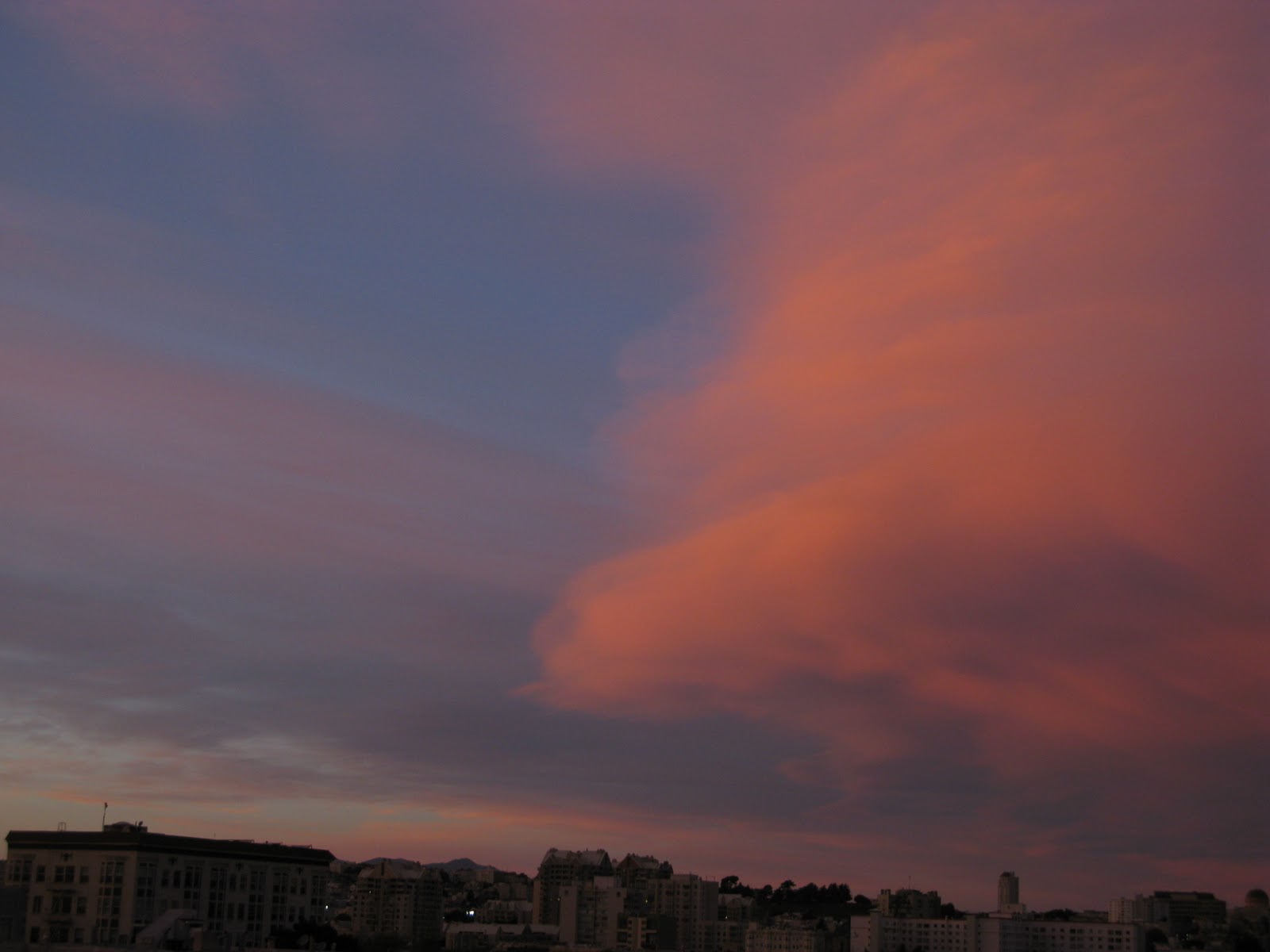
With the wind, beautiful sunsets. These are from yesterday at around five:

Study Hall - Shobogenzo
In the next three fascicles, Dogen happily takes potshots at those who are merely scholars; it is somewhat ironic that he is using the breadth of his own scholarship to do so, and that he can say, in 'Dharma Blossoms Turn Dharma Blossoms', 'Hokke Ten Hokke', speaking of the story of Fada and Huineng, "In order to fathom the true meaning of the dharma, thoroughly study the ancestor's teaching as a single great matter".
While this fascicle focuses on the Lotus Sutra and includes many quotations from it, the two versions of 'Ungraspable Mind', 'Shin Fukatoku', deal with Deshan, the Diamond Sutra scholar. Not content with retelling the famous story of his being stumped by the old woman selling refreshments, Dogen even goes on to tell Deshan how he should have proceeded, and how he could have tested if the woman was merely asking a fiendish question, or if she had a deep understanding (this reminds me of something my father wrote in a good luck card before my A-Level exams: "Remember that the greatest fool can ask more than the wisest person can answer"). In the expanded version, he includes the story of Huizhong and Daer, and again, takes it upon himself to criticise the clarifying statements of other ancestors, including ones that he elsewhere refers to as true teachers: "The five masters' views should be altogether seen through...these five old masters were not clear about Huizhong's teaching. It looks as if they did not pursue buddha dharma enough". I think the point he is making is that to make any statement about the ungraspability of mind is to miss the point. So he simply concludes by saying "Study mind that is ungraspable".
While this fascicle focuses on the Lotus Sutra and includes many quotations from it, the two versions of 'Ungraspable Mind', 'Shin Fukatoku', deal with Deshan, the Diamond Sutra scholar. Not content with retelling the famous story of his being stumped by the old woman selling refreshments, Dogen even goes on to tell Deshan how he should have proceeded, and how he could have tested if the woman was merely asking a fiendish question, or if she had a deep understanding (this reminds me of something my father wrote in a good luck card before my A-Level exams: "Remember that the greatest fool can ask more than the wisest person can answer"). In the expanded version, he includes the story of Huizhong and Daer, and again, takes it upon himself to criticise the clarifying statements of other ancestors, including ones that he elsewhere refers to as true teachers: "The five masters' views should be altogether seen through...these five old masters were not clear about Huizhong's teaching. It looks as if they did not pursue buddha dharma enough". I think the point he is making is that to make any statement about the ungraspability of mind is to miss the point. So he simply concludes by saying "Study mind that is ungraspable".
Monday, November 22, 2010
The Gate of Liberation Stands Open
I was thinking that the three ceremonies we are having in the space of a week were all somewhat different, but this is not really the case. On Friday night we had an intimate jukai and rakusu-giving ceremony, led by Shosan Victoria Austin, with Chris Shelton receiving the precepts, and Kathryn Stark renewing her vows with her new teacher.
Being the evening, we did not get the usual photo opportunities in the courtyard, but we gathered in the dining room instead. None of my flash-assisted photographs turned out at all good, so here is a grainy shot sans flash of Chris, Victoria and Kathryn:

Being the evening, we did not get the usual photo opportunities in the courtyard, but we gathered in the dining room instead. None of my flash-assisted photographs turned out at all good, so here is a grainy shot sans flash of Chris, Victoria and Kathryn:

This morning we all got to renew our vows with the Full Moon Ceremony, led by Jordan as the kokyo. As usual, I notice I was a little distracted until we had got through all the homages, but then I was much more focused by the time we got to the vows and precepts themselves.
On Wednesday evening, at the usual time for zazen, we will have our Thanksgiving Ceremony, which will include offering food for those whose needs are greater; and then, after a couple of days' holiday, right into Rohatsu...
Saturday, November 20, 2010
Stats
Well, the Flag Counter has been in a month, and it registers forty countries now, which I am delighted about, notwithstanding the fact that many of these may just be one person on one occasion. I have also seen China,Ukraine, Slovenia, Latvia, Netherlands, Georgia, and Venezuela show up on the Google stats in that time, so that brings it up further. The US spread is also growing, though mostly close to home:
Thank you all for tuning in.
| State | Unique Visitors | Last New Visitor | |||
| 1.1. |  | California | 526 | November 21, 2010 | |
| 1.2. |  | Texas | 22 | November 19, 2010 | |
| 1.3. |  | New Jersey | 18 | November 18, 2010 | |
| 1.4. |  | New York | 14 | November 17, 2010 | |
| 1.5. |  | Illinois | 13 | November 18, 2010 | |
| 1.6. |  | Oregon | 9 | November 19, 2010 | |
| 1.7. |  | Arizona | 5 | November 11, 2010 | |
| 1.8. |  | Minnesota | 5 | November 12, 2010 | |
| 1.9. |  | Washington | 5 | November 20, 2010 | |
| 1.10. |  | Pennsylvania | 4 | November 9, 2010 | |
| 1.11. |  | Wisconsin | 4 | November 20, 2010 | |
| 1.12. |  | Massachusetts | 4 | November 21, 2010 | |
| 1.13. |  | North Carolina | 4 | November 17, 2010 | |
| 1.14. |  | Ohio | 3 | November 17, 2010 | |
| 1.15. |  | Nevada | 3 | November 17, 2010 | |
| 1.16. |  | Idaho | 2 | November 5, 2010 | |
| 1.17. |  | Virginia | 2 | November 13, 2010 | |
| 1.18. |  | Florida | 2 | November 7, 2010 | |
| 1.19. |  | Maryland | 2 | November 2, 2010 | |
| 1.20. |  | Georgia | 2 | November 15, 2010 | |
| 1.21. |  | Michigan | 2 | November 18, 2010 | |
| 1.22. |  | West Virginia | 1 | October 25, 2010 | |
| 1.23. |  | Vermont | 1 | October 27, 2010 | |
| 1.24. |  | Iowa | 1 | October 27, 2010 | |
| 1.25. |  | Connecticut | 1 | November 9, 2010 | |
| 1.26. |  | South Dakota | 1 | November 11, 2010 | |
| 1.27. |  | South Carolina | 1 | November 12, 2010 | |
| 1.28. |  | New Mexico | 1 | November 13, 2010 | |
| 1.29. |  | Arkansas | 1 | November 17, 2010 | |
| 1.30. |  | Colorado | 1 | November 17, 2010 | |
| 1.31. |  | District of Columbia | 1 | November 18, 2010 | |
| 1.32. |  | Indiana | 1 | November 18, 2010 | |
 | Unknown | 14 | November 12, 2010 | ||
Thank you all for tuning in.
Thursday, November 18, 2010
Study Hall - Shobogenzo
Just as time flows forwards and backwards, and just as mountains flow, the transmission of the teaching is not simply how it appears to be. In 'Buddha Ancestors' and 'Document of Heritage', 'Busso' and 'Shisho', Dogen looks at the lineage, and the transmission documents that he was able to see in China. When he sees the documents offered by Abbot Yuanzi, in Damei's lineage, he says, touchingly, "Tears wet my sleeves" as he realised his good fortune in having such an opportunity, and he dreams of Damei and plum blossoms, just as the Abbot had before Dogen's arrival, and writes "This dream was as real as being awake. I have never before told this story to anyone in China or Japan".
But while he insists on the documents, just as he insists on the robe, as the emblem of the authentic teaching, he does not limit this to a linear transmission; he quotes his teacher Rujing saying "Because of this heritage from buddha to buddha until now, each buddha is an heir. Buddhas are not lined up, nor are they gathered together, but they just inherit from each other...We understand that Shakyamuni Buddha received dharma from Kashyapa Buddha, and Kashyapa Buddha received dharma from Shakyamuni Buddha. When you understand in this way, it is the true dharma heritage of all buddhas and ancestors".
In the kechimyaku blood vein lineage papers that we receive here at Zen Center, this is represented by the line that connects the teacher and disciple returning to an empty circle above Shakyamuni. Here is the one I received at my tokudo, which I just unfolded for the first time:

But while he insists on the documents, just as he insists on the robe, as the emblem of the authentic teaching, he does not limit this to a linear transmission; he quotes his teacher Rujing saying "Because of this heritage from buddha to buddha until now, each buddha is an heir. Buddhas are not lined up, nor are they gathered together, but they just inherit from each other...We understand that Shakyamuni Buddha received dharma from Kashyapa Buddha, and Kashyapa Buddha received dharma from Shakyamuni Buddha. When you understand in this way, it is the true dharma heritage of all buddhas and ancestors".
In the kechimyaku blood vein lineage papers that we receive here at Zen Center, this is represented by the line that connects the teacher and disciple returning to an empty circle above Shakyamuni. Here is the one I received at my tokudo, which I just unfolded for the first time:

Wednesday, November 17, 2010
The Coffee Made Me Do It
I am seeing the phrase "merging realization" in many of Dogen's fascicles, and each time I see it I think of merging traffic, so I am tempted to stretch the analogy: any time you are in a vehicle you are immediately traffic, and you can never be separate from traffic. Even though it may seem that when you merge onto the freeway, there is other traffic that you are joining, in reality there is only traffic. Traffic is not merely arising now; traffic abides in the phenomenal expression of traffic. Traffic may flow, but it is always traffic. Always traffic means the traffic may flow. Deeply consider the causes and conditions of traffic as you merge with it.
Monday, November 15, 2010
Study Hall - Shobogenzo
'Mountains and Waters Sutra', 'Sansuikyo', is an easy one to really get your teeth into. Turning our usual way of looking at things on its head, it dwells on the interconnection of phenomena and their essence without being as impenetrable as other fascicles. Dogen cautions: "When your understanding is shallow, you doubt the phrase Green mountains are always walking. When your learning is immature, you are shocked by the words 'flowing mountains'. Without fully understanding even the words 'flowing water', you drown in small vews and narrow understanding", just as in the Genjo Koan he says, with regard to how you see the ocean "you see and understand only what your eye of practice can reach". He even takes time to disparage some "bald-headed fellows" in China who prefer to throw up their hands and say that these statements are simply illogical. There are many exhortations to try harder: "Examine in detail the characteristics of the mountains' walking...Penetrate these words...Study and investigate this thoroughly...Pursue this beyond the limit of pursuit". He wants us to be free from conventional and limited views; being separate from mountains, or being separate from water is being separate from understanding.
Subscribe to:
Posts (Atom)
