As a final study hall post from me, something from Shohaku Okamura's newly-published Living by Vow, which I was naturally excited to pick up at the bookstore a couple of weeks ago:
"Usually, taking a vow is like making a promise: if we don't keep it, we feel bad, or fear that we might be punished. But vow in Buddism is not like that. It's not something we do with our intellect or shallow emotion. We vow toward the Buddha, toward something absolute and infinite. As a bodhisattva, we can never say, 'I have achieved all vows'. We cannot be proud of our achievements, because in comparison to the infinite, anything we achieve is insignificant. Each of us has different capabilities of course. If we cannot do very much, we practice just a little. There is no reason for us to feel small or to say we're sorry. We just try to be right there with this body and mind and move forward one step or half a step. This is our practice in a concrete sense.
Katagiri Roshi used the expression 'living in vow' because it sounds natural in English. I like 'living by vow', perhaps because D.T. Suzuki has this expression in his book Living by Zen. In the Japanese translation of this book, he says something like, 'All living beings are living in Zen, but only human beings can live by Zen'. Saying that all living beings - dogs, cats, plants, flowers - are living in Zen doesn't mean they abide in meditation or samadhi, but rather that they are living the reality of life as it is, or tathata in Sanskrit. Everything lives in the reality of life, in Zen; but only human beings have to make a conscious effort to do so. We devote ourselves to the study and practice of Zen, and consciously live by Zen. As Suzuki says, only human beings do this, but that doesn't mean we are superior to other beings. Because of our doubts and delusions we cannot simply live in reality. We have to consciously return to reality and make an effort to live on that basis."
Friday, August 31, 2012

Thursday, August 30, 2012
Warmth
San Franciscans know that Labor Day often heralds the beginning of the second half of the summer, and we have been doing nicely with the weather this week - to the extent that I took a very short lunch break yesterday so I could finish a little early and go and sit on the beach, which I haven't done for many months.
Typically for interim week, it has been very quiet on the work front - our staff meeting lasted just an hour, and I didn't have more than a couple of emails all afternoon. All of this has left me plenty of time to be cleaning up the ino's office. When I started in the position, I made a point of going through all the closets and filing cabinets to see what was there, and to have things organised in a way that made sense to me. There was stuff I intended to take further care of - for instance, pruning the contents of the filing cabinets, so that we just had one copy of sesshin schedules from ten years ago rather than eight - but then this tended to sit on my long to-do list, pushed to the background by more pressing needs on my time and energy. Now I can finally turn to them and leave things the way I would have liked them to have been all along - I could tolerate the messiness for myself, but would not wish to bequeath it to Valorie. Kind of like decorating a house before you sell it; the new owners may still come in and do it over, but at least you have the satisfaction of having made the effort, even if you don't get to enjoy the fruits of it for yourself.
One final round of sky pictures, to note the improved weather compared to the last sequence.
Typically for interim week, it has been very quiet on the work front - our staff meeting lasted just an hour, and I didn't have more than a couple of emails all afternoon. All of this has left me plenty of time to be cleaning up the ino's office. When I started in the position, I made a point of going through all the closets and filing cabinets to see what was there, and to have things organised in a way that made sense to me. There was stuff I intended to take further care of - for instance, pruning the contents of the filing cabinets, so that we just had one copy of sesshin schedules from ten years ago rather than eight - but then this tended to sit on my long to-do list, pushed to the background by more pressing needs on my time and energy. Now I can finally turn to them and leave things the way I would have liked them to have been all along - I could tolerate the messiness for myself, but would not wish to bequeath it to Valorie. Kind of like decorating a house before you sell it; the new owners may still come in and do it over, but at least you have the satisfaction of having made the effort, even if you don't get to enjoy the fruits of it for yourself.
One final round of sky pictures, to note the improved weather compared to the last sequence.
 |
| Yesterday morning, with a little marine layer still visible |
 |
| Yesterday evening |
 |
| This morning, a little earlier than yesterday and with more fog |
 |
| Yesterday evening |
 |
| This morning |
 |
| Yesterday evening |
 |
| This morning |
 |
| Yesterday evening - a good reminder that we have a Full Moon Ceremony coming up |
Tuesday, August 28, 2012
Interim
There is a sweet kind of irony in the fact of my last week as ino being interim; usually I welcome these weeks as a chance to recharge my batteries in the midst of the ongoing schedule. This time I have some free time ahead, and one or two people have suggested I should be wanting to cherish being in the ino seat for these last few days. Nevertheless I am enjoying some additional sleep, and will be devoting the extra time to making sure I have a lot of loose ends sorted out for Valorie not to have to deal with.
I do also find it helpful to step away from zazen occasionally, just to notice what happens if I don't sit for a couple of weeks; it is subtle, but I do feel a difference in how I respond to things, how my brain feels; it is nice to come back to the cushion with renewed purpose, as I did after my time in England a few months ago.
Also, when the weather is co-operating, as it was this morning, I have a chance to take pictures in the morning sun before breakfast, which is revitalising in and of itself:
I do also find it helpful to step away from zazen occasionally, just to notice what happens if I don't sit for a couple of weeks; it is subtle, but I do feel a difference in how I respond to things, how my brain feels; it is nice to come back to the cushion with renewed purpose, as I did after my time in England a few months ago.
Also, when the weather is co-operating, as it was this morning, I have a chance to take pictures in the morning sun before breakfast, which is revitalising in and of itself:
 |
| Looking towards the Itasonten altar |
 |
| One of the dining room statues |
 |
| In the dining room |
 |
| In the dining room |
 |
| Okay, this was posed, but I have been meaning to do a shot like this for a while |
 |
| A corner of the courtyard |
Monday, August 27, 2012
Study Hall
A last offering from Dogen's Genjo Koan, Three Commentaries - Uchiyama Roshi's look at the final paragraph of the fascicle, which starts:
I would like to use another example. We human beings can be physically alive precisely because we breathe a breath each moment, right now, right here. If we think that because we breathed a lot in the past, we don't need to breathe right now, we will die. In the same way, if we think that because we practised a lot and attained enlightenment in the past, we don't need to practise anymore, such enlightenment is already dead.
Living enlightenment is the same as breathing each moment; we arouse bodhi-mind, moment by moment, billions of times, and practice right now and right here. This is called shusho-ichinyo (practice and verification are one) or shojo-no-shu (practice/enlightenment. This is the way life is."
"Zen master Baoche of Mount Mayu was fanning himself. A monk approached and said, 'Master, the nature of wind is permanent and there is no place it does not reach. Why, then do you fan yourself?' 'Although you understand that the nature of wind is permanent;' Baoche replied, 'you do not understand the meaning of its reaching everywhere.' 'What is the meaning of its reaching everywhere?' asked the monk again. The master just kept fanning himself. The monk bowed deeply.""This is a very simple story that we can understand without much explanation. Although the wind-nature is ever present in heaven and earth, if we don't use a fan, the wind is not actualized. If we don't use a fan, we don't have wind.
I would like to use another example. We human beings can be physically alive precisely because we breathe a breath each moment, right now, right here. If we think that because we breathed a lot in the past, we don't need to breathe right now, we will die. In the same way, if we think that because we practised a lot and attained enlightenment in the past, we don't need to practise anymore, such enlightenment is already dead.
Living enlightenment is the same as breathing each moment; we arouse bodhi-mind, moment by moment, billions of times, and practice right now and right here. This is called shusho-ichinyo (practice and verification are one) or shojo-no-shu (practice/enlightenment. This is the way life is."
Sunday, August 26, 2012
Harmonies
When Alan and Danny first proposed the Revelation Zen evening as part of the Soundwave Festival, there was a concern that we didn't simply replicate the Bold Italic evening, although from our side of things, that was always going to be our reference point. It was another occasion to open the doors of City Center to people who don't usually come - and I heard several people saying that they lived in the neighbourhood but had never made it through the front door - and to open up our activities in a less formal and forbidding way and in completely different contexts. I was only peripherally involved in terms of organising; this meant I wasn't particularly stressed about Saturday rolling around, but I was busy all afternoon helping carry, fetch and find - tables, extension cords, the usual little things. It was almost a surprise when at 5:30 a steady line of people started flowing through the front door. Even more surprising was how quiet everyone was - at least until the music started.
We had a full Buddha Hall by the time we had got through the introductions, and David led some zazen, which segued into Marielle's performance. She started with the big bell, worked the recordings of the bell in, and then moved onto violin, with harmonies building from the deep bass resonance of the bell. I had tipped Keith off, and he was sitting right next to the bell to get the feel of it, his hands cupped around a blown-up latex glove, which I guess was standing in for a balloon as a vibration detector (just visible in the photo below).
Gretchen led as many people as we could fit into the courtyard in walking meditation, accompanying which Sean ran a whole bank of tapes, creating a wash of sound; we wrapped up with a chanting of the Enmei Jukku Kannon Gyo, during which I could mostly hear Blanche, who was luckily keeping count for me as I played the mokugyo, and as we got to the end of the chant, En came in with some increasingly processed crash cymbal leading into some pretty intense layering of fequencies and harmonies.
I deeply enjoyed all the music, and appreciated how our focus on meditative activities added an extra dimension and attention. I was also musing on the role trance music has played in spiritual activities for many centuries: it occurred to me that while there can often be noise within silence, as our minds start to chatter to fill the disquieting void, within sound, especially unstructured sound which give the brain nothing to cut up and count, there can be a real silence and spaciousness.
After which, there is always the cleaning up. Luckily, since it was past our bedtime, there was a great crew of volunteers, with special mention to Jorge, the Soundwave engineer who was on top of everything all day, and the half-dozen or so YUZ members who descended on anything that needed to be put away, mob-handed and full of energy.
We had a full Buddha Hall by the time we had got through the introductions, and David led some zazen, which segued into Marielle's performance. She started with the big bell, worked the recordings of the bell in, and then moved onto violin, with harmonies building from the deep bass resonance of the bell. I had tipped Keith off, and he was sitting right next to the bell to get the feel of it, his hands cupped around a blown-up latex glove, which I guess was standing in for a balloon as a vibration detector (just visible in the photo below).
Gretchen led as many people as we could fit into the courtyard in walking meditation, accompanying which Sean ran a whole bank of tapes, creating a wash of sound; we wrapped up with a chanting of the Enmei Jukku Kannon Gyo, during which I could mostly hear Blanche, who was luckily keeping count for me as I played the mokugyo, and as we got to the end of the chant, En came in with some increasingly processed crash cymbal leading into some pretty intense layering of fequencies and harmonies.
I deeply enjoyed all the music, and appreciated how our focus on meditative activities added an extra dimension and attention. I was also musing on the role trance music has played in spiritual activities for many centuries: it occurred to me that while there can often be noise within silence, as our minds start to chatter to fill the disquieting void, within sound, especially unstructured sound which give the brain nothing to cut up and count, there can be a real silence and spaciousness.
After which, there is always the cleaning up. Luckily, since it was past our bedtime, there was a great crew of volunteers, with special mention to Jorge, the Soundwave engineer who was on top of everything all day, and the half-dozen or so YUZ members who descended on anything that needed to be put away, mob-handed and full of energy.
 |
| Tova led a couple of tours of the building |
 |
| Lien offered zazen instruction |
 |
| Marielle played her violin along with the big bell |
 |
| Sean acquires a peace bell halo |
 |
| Sean and kinhin taken from my room |
 |
| En, with special effect caused by having my hand in front of the lens before taking the picture |
Friday, August 24, 2012
Coming And Going
It is always interesting to watch our expectations get confounded. This was my last weekday morning sitting in the ino seat in the zendo, so I wanted it to be a nice calm and spacious time. Instead, my alarm clock didn't go off, so I was a little groggy and rushed, the emergency light right above my head in the zendo started to flash in an unusual way, there was a smoke detector beeping periodically in the hallway somewhere, and I was handed a note that the shoten wasn't feeling well, so I had to think about a replacement.
It was also my last time bringing out the tsui-ching. Naturally I was thinking back to my first time with it, when we entered Liping as the shuso (I wasn't writing the blog then, but I reflected on it a year later). Today as well I reminded myself not to be in a rush, as we said goodbye to Konin (not for the first time, as I find this, looking for the other posts I am linking to, which also has a fuller description of the ceremony). She being quite adept, we had not discussed the form for the ceremony ahead of time, and I noticed I was a little disappointed when I came back round to the tsui-ching after the jundo to find she had turned to face Blanche. Normally, making the announcement face to face is the strongest part of the ceremony for me. My voice, which can range between fierce (my impression anyway) and soft (how I remember it with Roxie, for instance), seemed plain straight-forward this time. Vicki asked the questions, which Konin handled deftly, and Blanche gave the stirring goodbyes for us.
Senior staff were scheduled to have lunch together today, to mark the dissolution of this particular incarnation with its built-in European majority - we were saying goodbye to Konin, Rose the tenzo, who is going back to Switzerland for a year to be a grandmother, and myself. Luckily, we avoided any embarrassing speechifying, and just got to enjoy the good food and the good company.
It was also my last time bringing out the tsui-ching. Naturally I was thinking back to my first time with it, when we entered Liping as the shuso (I wasn't writing the blog then, but I reflected on it a year later). Today as well I reminded myself not to be in a rush, as we said goodbye to Konin (not for the first time, as I find this, looking for the other posts I am linking to, which also has a fuller description of the ceremony). She being quite adept, we had not discussed the form for the ceremony ahead of time, and I noticed I was a little disappointed when I came back round to the tsui-ching after the jundo to find she had turned to face Blanche. Normally, making the announcement face to face is the strongest part of the ceremony for me. My voice, which can range between fierce (my impression anyway) and soft (how I remember it with Roxie, for instance), seemed plain straight-forward this time. Vicki asked the questions, which Konin handled deftly, and Blanche gave the stirring goodbyes for us.
Senior staff were scheduled to have lunch together today, to mark the dissolution of this particular incarnation with its built-in European majority - we were saying goodbye to Konin, Rose the tenzo, who is going back to Switzerland for a year to be a grandmother, and myself. Luckily, we avoided any embarrassing speechifying, and just got to enjoy the good food and the good company.
Thursday, August 23, 2012
Thirteen Conversations About One Thing
In some ways we have come full circle. These days people are asking me when my last day as ino will be - September 1st; what I will be doing during September - as little as possible, with an outing to Tassajara work period with a group from Young Urban Zen the only definite thing on my agenda; whether I am looking forward to going to Tassajara - of course, any time I go down is something to look forward to; how long I am going for - just the three months as best as I can predict now; and what am I going to be doing when I come back - as usual, there is an idea for me, but how that will translate into reality in a few months' time is anybody's guess.
'Nowhere-else mind' notwithstanding, I have found myself recently with images of Tassajara floating into my mind, sense impressions from other times: the smell and feel of the dusty path down through the cabins before the sun comes up; the intense freshness of the morning air as we walk up to the zendo with stars overhead; the blue jays chattering as they stir and decide it is time to look for some breakfast at first light; the sound of the han or the drum dying away in the open air, with none of the easy confinement of the instruments in this building.
Naturally I was looking for some photos to illustrate this, and I found that few of my pictures are actually of the quiet corners or ordinary moments, of which there are many.


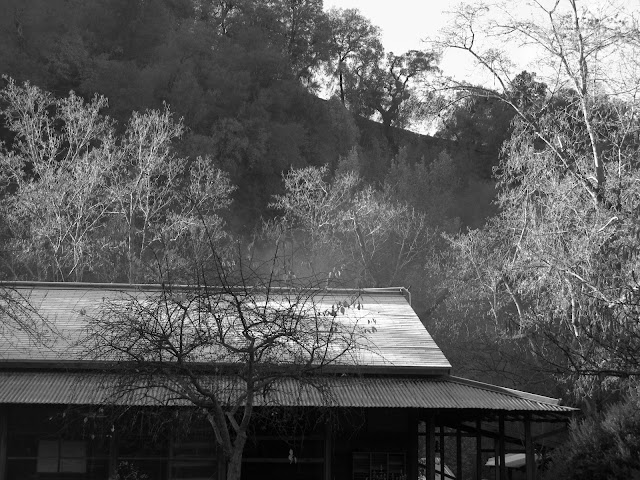
'Nowhere-else mind' notwithstanding, I have found myself recently with images of Tassajara floating into my mind, sense impressions from other times: the smell and feel of the dusty path down through the cabins before the sun comes up; the intense freshness of the morning air as we walk up to the zendo with stars overhead; the blue jays chattering as they stir and decide it is time to look for some breakfast at first light; the sound of the han or the drum dying away in the open air, with none of the easy confinement of the instruments in this building.
Naturally I was looking for some photos to illustrate this, and I found that few of my pictures are actually of the quiet corners or ordinary moments, of which there are many.


Wednesday, August 22, 2012
Study Hall
"According to the Zen tradition, when Shakyamuni Buddha attained enlightenment, he said, 'I, the great earth, and sentient beings simultaneously attained the Way; mountains, rivers, grass, and trees have all become Buddha.' In the Lotus Sutra, there is an expression, 'Ten directions are all within Buddha's land.' The Kanmuryojo-kyo (Sutra of Seeing Infinite Life, one of the three major sutras of Pure Land Buddhism) says, 'The light of the Tathagatha of Infinite Life (Amitabha) embraces all living beings without rejecting any.' We have already been enlightened by Shakyamuni Buddha, and are from the beginning in the hands of Amitabha Buddha, who saves all living beings without exception. This is not a matter of understanding it or not. Whether we know it or not, whether we say I don't believe in Amitabha or not, it is true. It is not a problem. The light of Amitabha embraces all living beings whether we believe it or not.
The reality of life or the 'Life of Buddha' is thus. And yet, all of us think and measure and say, 'I don't believe it.' Don't say such cheeky things! The force which makes us think that our minds are great and makes us say such cheeky things itself wells up from the power of Amitabha or the 'Life of Buddha'. We must deeply understand that whether we think so or not, believe it or not, understand it or not, venerate it or not, accept it or reject it, in whatever conditions, we are living out the formless reality of life prior to its division into dichotomies" - Kosho Uchiyama, Dogen's Genjo Koan, Three Commentaries.
The reality of life or the 'Life of Buddha' is thus. And yet, all of us think and measure and say, 'I don't believe it.' Don't say such cheeky things! The force which makes us think that our minds are great and makes us say such cheeky things itself wells up from the power of Amitabha or the 'Life of Buddha'. We must deeply understand that whether we think so or not, believe it or not, understand it or not, venerate it or not, accept it or reject it, in whatever conditions, we are living out the formless reality of life prior to its division into dichotomies" - Kosho Uchiyama, Dogen's Genjo Koan, Three Commentaries.
Subscribe to:
Posts (Atom)
